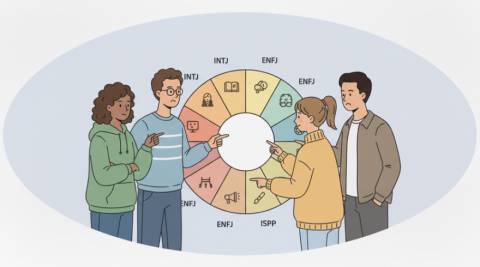
Take Myers-Briggs Personality Test Online
What the MBTI Is and Isn’t
People are naturally curious about why they think, decide, and relate the way they do, which is why a type framework continues to attract attention. As a shorthand for this curiosity, many people explore the Myers-Briggs personality test as a way to examine preference patterns rather than to assign permanent labels. Instead of claiming to measure ability or mental health, the approach highlights where energy flows, how information is noticed, what logic or values guide decisions, and how structure is approached. Used well, it becomes a reflective scaffold that supports self-awareness and open dialogue.
Historical context matters because the tool grew from Jungian psychological ideas and evolved through iterative development and validation studies. When terminology is used with precision, practitioners describe the Myers-Briggs type indicator test as a self-report inventory that yields a four-letter type code grounded in dichotomous preferences. The emphasis on preferences means results describe likely comfort zones, not fixed capabilities, and certainly not moral worth. Results also benefit from interpretation, because nuance appears in facet-level insights, situational demands, and developmental growth across a lifespan.
Accessibility has expanded as interest has spread across education, organizations, and coaching communities worldwide. In many regions, providers offer the MBTI test english interface alongside localized translations so that instructions and item wording remain clear. Quality translation matters, because subtle wording changes can shift how respondents interpret meaning and choose responses. Regardless of language, the best experience includes context, coaching, and opportunities to discuss results thoughtfully.
The Four Dichotomies and the 16 Types
The framework rests on four paired preference dimensions that blend into sixteen recognizable type patterns. In practical terms, many first encounter these ideas through the Myers-Briggs type indicator MBTI test, which presents forced-choice items to surface the directions people tend to favor. The resulting code is a convenient label, yet the real value lies in understanding how each letter interacts with others during stress, collaboration, and decision-making. Depth emerges when people compare similar types that differ by a single letter and notice the real-world effects.
Each dimension can be summarized concisely for quick reference and coaching conversations, and a side-by-side view can make the core contrasts easier to grasp at a glance.
| Dimension | Preference | Focus of Attention | Helpful Tip |
| Energy | Extraversion (E) | Outward engagement, interaction, immediacy | Pause to reflect before committing to action |
| Energy | Introversion (I) | Inner reflection, depth, measured pace | Share emerging ideas earlier to invite input |
| Information | Sensing (S) | Facts, present details, tangible data | Zoom out to consider patterns and possibilities |
| Information | Intuition (N) | Connections, future patterns, big-picture | Ground ideas with examples and real constraints |
| Decisions | Thinking (T) | Logic, criteria, consistency | Consider impact on people and values explicitly |
| Decisions | Feeling (F) | Values, harmony, empathy | Clarify trade-offs and decision principles upfront |
| Structure | Judging (J) | Plans, closure, milestones | Leave room for adaptation and iteration |
| Structure | Perceiving (P) | Options, exploration, flexibility | Timebox choices to reduce decision fatigue |
Once people learn the letters, they often want an approachable entry point before pursuing deeper resources. In popular communities, the casual nickname for the sixteen-type model sometimes appears as the MBTI test 16 personalities test free, although branding and psychometric lineage differ across platforms. For those comparing sources, it is essential to verify whether a site offers an official instrument or a look-alike labeled as the Myers-Briggs type indicator MBTI test free alternative so expectations match the level of rigor you need.
Benefits and Real-World Applications
Understanding preference patterns can improve how teams communicate, plan projects, and navigate conflict in high-stakes settings. In career exploration, many job seekers notice that the Myers-Briggs test can spark language for transferable strengths and development goals. Managers often use type awareness to design meetings that fit different energy levels and thinking styles, which raises participation and creativity. Educators adapt instruction to balance concrete details with conceptual connections so that both sensing and intuitive learners engage fully.
- Boost collaboration by clarifying who prefers rapid ideation and who values structured agendas
- Reduce miscommunication by translating ideas into both tangible examples and big-picture narratives
- Enhance decision-making by pairing analytical criteria with stakeholder impact mapping
- Strengthen feedback culture by matching delivery style to receiver preferences
- Support career development with language that highlights natural motivators and blind spots
Accessibility has also expanded the reach of type learning for career changers and students seeking self-knowledge on a budget. In many introductory contexts, newcomers appreciate when a provider clearly labels a resource such as an MBTI test free screening to set expectations about depth and accuracy. For ongoing reflection and group learning, some communities host platforms that provide a guided experience akin to a Myers-Briggs test free online tutorial with practical exercises and debrief prompts.
Taking the Assessment Responsibly
Accurate results depend on context, mindset, and how honestly you respond to item pairs under typical conditions. When budgets are tight, some individuals explore a Myers-Briggs test free option to get a preliminary read before engaging in a more formal process. Regardless of source, it helps to answer based on usual behavior rather than aspirational traits you think others expect. After receiving a type code, validate it by reviewing descriptions, stress patterns, and decision examples from your real life.
- Use results as a conversation starter, not a decision-making mandate
- Avoid stereotyping; preferences describe comfort zones, not competence ceilings
- Revisit type under new roles or life phases to account for evolving habits
- Pair type with other evidence, such as 360 feedback and performance data
- Seek trained interpretation when applying insights to hiring or leadership selection
Convenience matters, but so does data privacy and clarity about what a questionnaire can and cannot conclude. For remote teams and global learners, some providers supply an option comparable to an MBTI test free online pathway, which can be useful for initial exploration as long as limitations are acknowledged. Professional settings should prioritize validated instruments, structured debriefs, and clear ethical guidelines to prevent misuse.
FAQ: Clear Answers to Common Questions
Does a four-letter type describe my whole personality?
No single label can capture a full human being, and type is best viewed as one lens among many. The framework highlights preference patterns that affect energy, information processing, decision-making, and approach to structure. People show a wide range of behaviors across situations, so use the model as a guide to likely comfort zones rather than a box.
Can type change over time?
Preferences feel stable for many adults, yet life experience, role demands, and deliberate practice can shift how comfortable you feel with each side of a dichotomy. Some people revise their reported type after reflection or coaching, especially when stress or situational pressures influenced earlier responses. Revalidation helps ensure your reported code aligns with lived behavior.
Is the MBTI scientifically valid?
As with many psychological tools, evidence is mixed and depends on what claims are being tested, how reliability is measured, and whether trained interpretation is included. The instrument’s best uses focus on development, communication, and self-reflection, not high-stakes selection. When applied with nuance, people often find the language practical for team alignment and coaching.
Where can I try a budget-friendly option?
Exploration can start with introductory questionnaires that emphasize learning rather than certification-grade precision. Some platforms advertise offerings similar to a Myers-Briggs type indicator test free experience, and these can be useful for curiosity, provided you validate results against detailed descriptions. For critical workplace decisions, consider a validated instrument paired with a qualified practitioner.
How should teams introduce type without stereotyping?
Begin with a clear purpose, such as improving meetings or clarifying decision roles, and emphasize that every preference has strengths and blind spots. Invite people to self-verify their reported code and share examples of when they flex toward the opposite side. Reinforce that competence exists across all types, and that diversity of preferences strengthens collective problem-solving.