What Myers-Briggs Type Indicator Is Really About
Across workplaces and classrooms, the name most people know, Myers-Briggs, points to a shared vocabulary that makes everyday collaboration less mysterious. People recognize themes like introversion and extraversion, sensing and intuition, thinking and feeling, judging and perceiving, but they are often surprised by how nuanced those preferences can be in real life. The explanatory power is not in boxing anyone in, but in clarifying how strengths show up and how blind spots can be managed thoughtfully.

As the framework matured, practitioners sought a consistent instrument and reporting method, and the designation Myers-Briggs type indicator became widely recognized in organizational development. The tool’s goal is to surface a best-fit type through both item responses and reflective verification, since context and life experience can color how people answer. By blending data with dialogue, coaches and trained facilitators help participants turn results into meaningful insights and next steps.
Evidence-Based Insights
Historically minded readers sometimes encounter the phrase Myers-Briggs personality inventory, a nod to the tool’s lineage as a structured self-report measure. That term highlights its role in self-understanding, not as a diagnostic label or a measure of mental health. When used ethically, the instrument invites curiosity, encourages evidence-based self-reflection, and supports respectful conversations about difference.
How the Assessment Works and What It Measures
In popular culture, a Myers-Briggs personality test typically asks forced-choice questions to illuminate your energy source, information style, decision lens, and lifestyle rhythm. The insight arrives as a narrative that helps you recognize strengths, potential derailers, and growth opportunities. Good reports emphasize that preferences are normal, valuable, and develop with use, avoiding any suggestion that one side is inherently better. For certified administrations, the Myers-Briggs type indicator test pairs psychometric scoring with a best-fit conversation so that the participant owns the outcome. That verification step protects against momentary mood, role pressure, or social desirability bias steering the result. Practitioners then connect type patterns to concrete behaviors, building a bridge from abstract letters to practical habits you can try tomorrow.
Outside formal settings, a quick Myers-Briggs test may spotlight tendencies that can be validated through real-life scenarios. By journaling, asking for feedback, and observing energy patterns across your week, you can confirm whether the reported code genuinely fits. The most robust insights appear when self-report is combined with thoughtful reflection and behavior experiments in the real world.

Practical Advantages and Everyday Applications
Many organizations rely on the shared lexicon because the Myers-Briggs type indicator MBTI provides a framework for scalable learning. When onboarding, career development, and leadership curricula use consistent terms, participants can transfer insights between roles and projects. The result is a culture that normalizes productive tension, encourages perspective-taking, and aligns strengths with the demands of the work.

Making the Most of It
For seekers of the most accurate Myers-Briggs test, expectations matter as much as item quality. No self-report can capture every nuance, so the goal is to find a process that pairs solid measurement with best-fit reflection. Practical payoffs show up in better one-on-ones, clearer decision protocols, healthier conflict, more resilient change efforts, and smarter career bets that honor how you naturally operate.
Understanding the 16 Myers-Briggs Personality Types
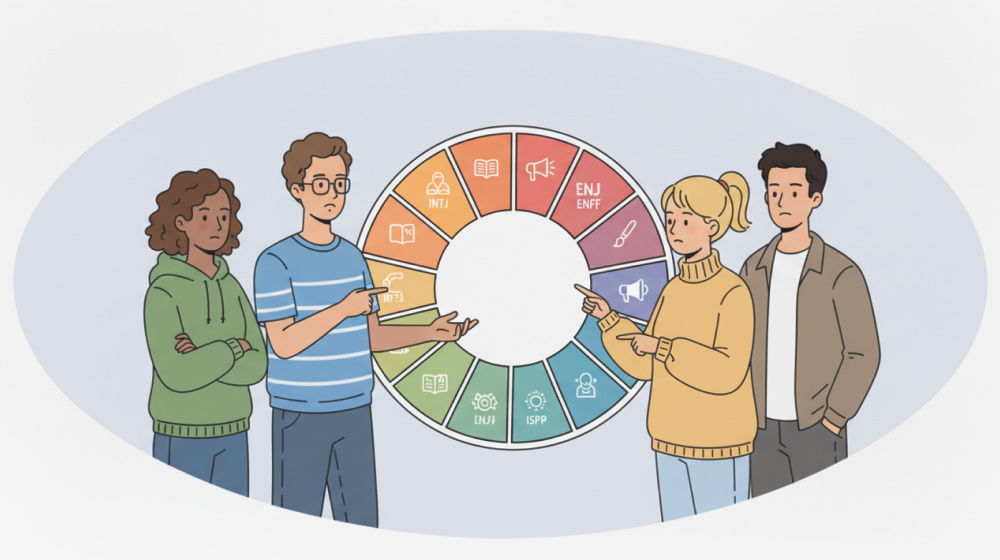
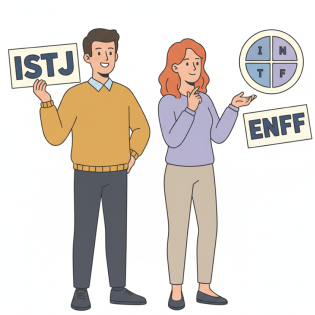
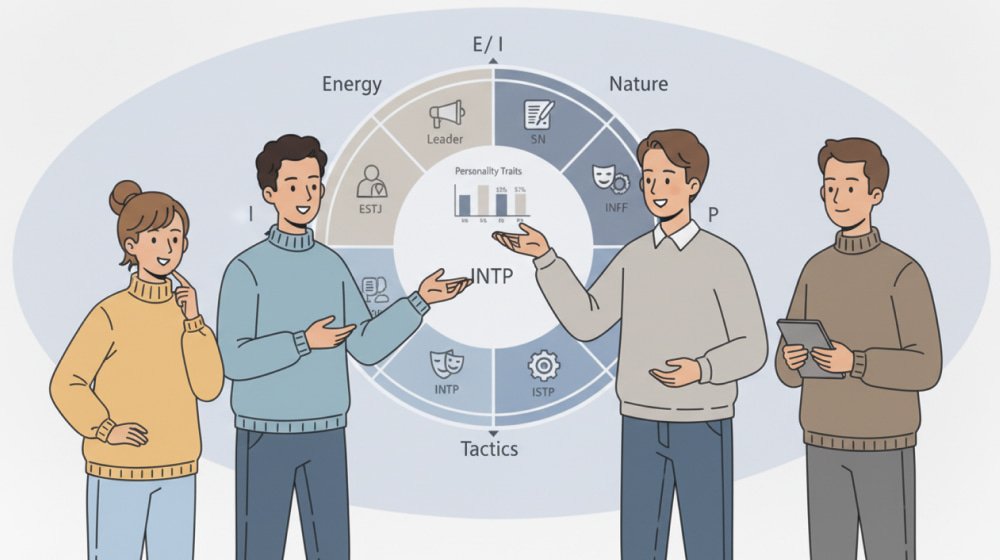
Sixteen code combinations emerge from the four preference pairs, each describing a distinct pattern of attention, information, decision-making, and organization. While no summary can do justice to the richness of a person, short profiles help you anticipate what energizes someone and what misfires under stress. The smartest way to use type snapshots is as hypotheses you test through conversation and observation, not as labels that freeze people in place.
| Dichotomy | Letter Pair | What It Describes |
|---|---|---|
| Energy Direction | E vs. I | Focus on the outer world of people and activity versus the inner world of reflection and ideas. |
| Information | S vs. N | Preference for concrete facts and present realities versus patterns, possibilities, and future implications. |
| Decisions | T vs. F | Emphasis on logical analysis and principles versus values, empathy, and impact on people. |
| Organization | J vs. P | Desire for structure, closure, and planning versus flexibility, openness, and adapting as you go. |
Many newcomers discover the landscape through 16 personalities Myers-Briggs explainers that translate otherwise technical ideas into engaging, story-like type portraits. Those summaries can be a friendly first step, yet it helps to check them against your lived experience and to notice where the descriptions fit and where they do not. Nuance increases as you explore dynamics like stress responses, communication cues, and team roles. Before diving into any Myers-Briggs test online, consider what decision you want your results to inform and how you will validate the fit. Curiosity and humility keep the process grounded, especially when your workplace, culture, or current role nudges you to act against preference. Treat any output as a conversation starter that points to experiments you can try during the next project or sprint.
Budget-Friendly Options
Assessment quality and ethics vary widely, so it pays to be an informed consumer. Official channels pair robust scoring with best-fit verification, while casual quizzes provide a lighter snapshot that still can spark insight. For those exploring budget-friendly options, a mention like Myers-Briggs test free often signals a short, simplified questionnaire whose results should be treated as provisional and validated over time.
Making the Most of Online Myers-Briggs Test
Convenience is a major draw, especially for remote teams and busy professionals who need quick insights to start a development plan. Because online experiences range from research-backed to purely recreational, it’s smart to read the fine print and consider how results will be used. If you opt for convenience, a carefully designed MBTI test for free can still prompt helpful reflection when paired with journaling and feedback from colleagues.

Licensing and interpretation matter as much as the item pool, particularly when results will guide hiring, promotion, or high-stakes decisions. Ethical practice keeps type out of selection and uses it for development, communication, and team health instead. When trying broad access tools, a widely shared option such as a Myers-Briggs test free online may be fine for curiosity, provided you follow up with real-world tests of fit and a conversation with a knowledgeable coach. Resource mixes can include workshops, coaching sessions, and self-paced learning paths tailored to your context. Thoughtful organizations link insights to role expectations, performance conversations, and change initiatives so lessons stick. If you’re surveying the landscape, listings that reference a free Myers-Briggs test should prompt questions about validity evidence, reporting clarity, and the presence of a best-fit step that helps you confirm results.
FAQ: Your Top Questions Answered
The Latest News
Please Note
This website (myersbriggstesthub.com) is not an official representative, creator or developer of this application, or product. All the copyrighted materials belong to their respective owners. All the content on this website is used for educational and informative purposes only.